
End of Winter Car Care: 7 Things to Check on Your Vehicle Before Spring Arrives in Arizona and New Mexico
Winter may not hit Arizona and New Mexico the same way it hits the Midwest, but that doesn’t mean your car got through it untouched. Cold morning startups, fluctuating temperatures between Albuquerque’s higher elevation and Phoenix’s valley heat, and months of daily driving all take a measurable toll on your vehicle’s critical systems. Before spring travel ramps up and summer heat arrives, now is the time to check what winter did to your car and fix it before something fails on the road.
What you need to know:
- Cold cycling weakens your car battery over time, and most drivers don’t notice until it fails completely. A load test now can tell you exactly where your battery stands before warmer months add even more stress.
- Tire pressure changes with temperature. As spring temperatures climb in the Phoenix metro and Albuquerque area, your tires need to be checked against the manufacturer’s specification on your driver’s door jamb, not the number printed on the sidewall.
- Oil contamination from winter driving is real. Short trips and cold starts let moisture accumulate in your engine oil. A spring oil change gives your engine clean protection heading into the most demanding season of the year.
1. Battery Health: The Silent Winter Casualty
Your battery works hardest in cold weather. Every cold start demands more power from the battery because engine oil thickens and the chemical reactions inside the battery itself slow down. Over a full winter, that repeated strain reduces the battery’s capacity, even if it still starts the car every morning.
The problem is that a weakened battery doesn’t always give you warning. It might start your car 99 times and then fail on the 100th. A professional load test measures the battery’s actual remaining capacity and tells you whether it’s healthy, marginal, or ready to fail.
In Arizona, batteries face an additional challenge: the summer heat that’s coming will accelerate degradation even further. A battery that barely survived winter often won’t make it through a Phoenix summer. Testing now gives you time to replace on your schedule rather than on the side of the road.
Dugger’s Road Rescue provides mobile battery testing and replacement. We come to your home, your office, or wherever you are and test on site. If the battery passes, we’ll tell you. If it doesn’t, we can replace it right there. Call (877) 823-9696.
2. Tires: Pressure, Tread, and What Winter Left Behind
Tire pressure fluctuates with temperature. For roughly every 10 degrees of temperature change, tire pressure shifts by about 1 PSI. That means tires that were properly inflated in January might be overinflated as March temperatures climb into the 70s and 80s in Phoenix.
Check your tire pressure against the manufacturer’s recommended specification. This number is printed on a sticker inside the driver’s door jamb. It is not the number molded into the tire sidewall. The sidewall number is the maximum pressure the tire can hold, not the pressure your vehicle was designed to ride on. Inflating to the sidewall number reduces your contact patch and can affect handling and braking.
While you’re checking pressure, inspect the tread. Look for uneven wear patterns that could indicate an alignment issue. Check for cracking in the sidewalls, especially if you park outdoors. Arizona’s UV exposure degrades rubber even when you’re not driving. Tires that look fine on the tread surface can have compromised sidewalls from sun damage.
Don’t forget the spare. If you have a flat on I-40 between Albuquerque and Flagstaff, a spare with no air pressure is the same as no spare at all.
3. Engine Oil: Winter Contamination Is Real
Cold starts are the hardest moment for your engine oil. When you start a cold engine, the oil hasn’t circulated yet and metal components are running with minimal lubrication for the first few seconds. Short trips compound the problem because the engine never reaches full operating temperature, which means moisture from combustion byproducts never burns off. That moisture stays in the oil, diluting its protective properties.
If most of your winter driving has been short trips around town, your oil is carrying more contamination than the odometer suggests. A spring oil change clears that out and gives your engine fresh protection before summer heat adds thermal stress to the equation.
Whether your vehicle calls for synthetic or conventional oil depends on the manufacturer’s specification, not a sales pitch. At Dugger’s Automotive on Camelback Road in Glendale, we check your owner’s manual recommendation and use what your engine was designed for. Call (505) 718-0412 or stop by. No appointment needed.
4. Brakes: Inspect Before the Heat Arrives
Brake pads wear gradually, and winter driving with frequent stops adds up. If you’re hearing any squealing or feeling any pulsation when you brake, now is the time to have them inspected. Catching brake issues in March means a straightforward pad replacement. Waiting until July, when Phoenix temperatures push pavement surface temps past 150 degrees and brake systems are under maximum thermal stress, often turns a pad replacement into a rotor and pad job that costs significantly more.
Brake fluid is another item worth checking. It absorbs moisture over time, which lowers its boiling point. In extreme heat, moisture contaminated brake fluid can boil under heavy braking, causing a spongy pedal or reduced stopping power. A simple fluid check now prevents a dangerous situation later.
5. Coolant: Verify Level and Mixture Before Summer
Your cooling system is about to become the most important system in your car. Arizona summer temperatures push engines hard, and your coolant is the only thing standing between normal operation and overheating. Check the coolant reservoir while the engine is cold. The level should be between the minimum and maximum marks.
The coolant mixture matters as much as the level. A 50/50 mix of antifreeze and water is standard, and it provides both freezing protection for Albuquerque’s occasional cold snaps and boiling protection for Phoenix summers. Straight water overheats. Straight antifreeze doesn’t transfer heat efficiently. If you’re unsure of the mixture, any repair facility can test it in seconds.
6. Wiper Blades and Lights: The Simple Checks That Matter
Wiper blades take a beating from UV exposure and dust. If your wipers streak, skip, or chatter across the windshield, replace them now. Arizona monsoon season starts in June, and compromised wipers in a sudden downpour are a visibility hazard. This is a five minute replacement at any auto parts store or at Dugger’s Automotive.
Walk around your car and check every light: headlights, taillights, brake lights, turn signals, and reverse lights. A burned out taillight is a ticket waiting to happen, and it’s also a safety issue that takes two minutes to fix. While you’re at it, clean your headlight lenses. Oxidized, hazy lenses reduce your nighttime visibility significantly.
7. Emergency Kit: Refresh and Restock for Spring
If you have an emergency kit in your car, now is the time to open it and check everything. Replace any expired items. Swap out cold weather gear for warm weather essentials: extra water (at least a gallon per person), a windshield sunshade, sunscreen, and a fully charged portable phone charger.
If you don’t have an emergency kit, build one. A basic desert driving kit should include water, jumper cables or a portable jump pack, a flashlight with fresh batteries, basic tools, a first aid kit, reflective triangles or flares, and a phone charger that works from your car’s 12V outlet.
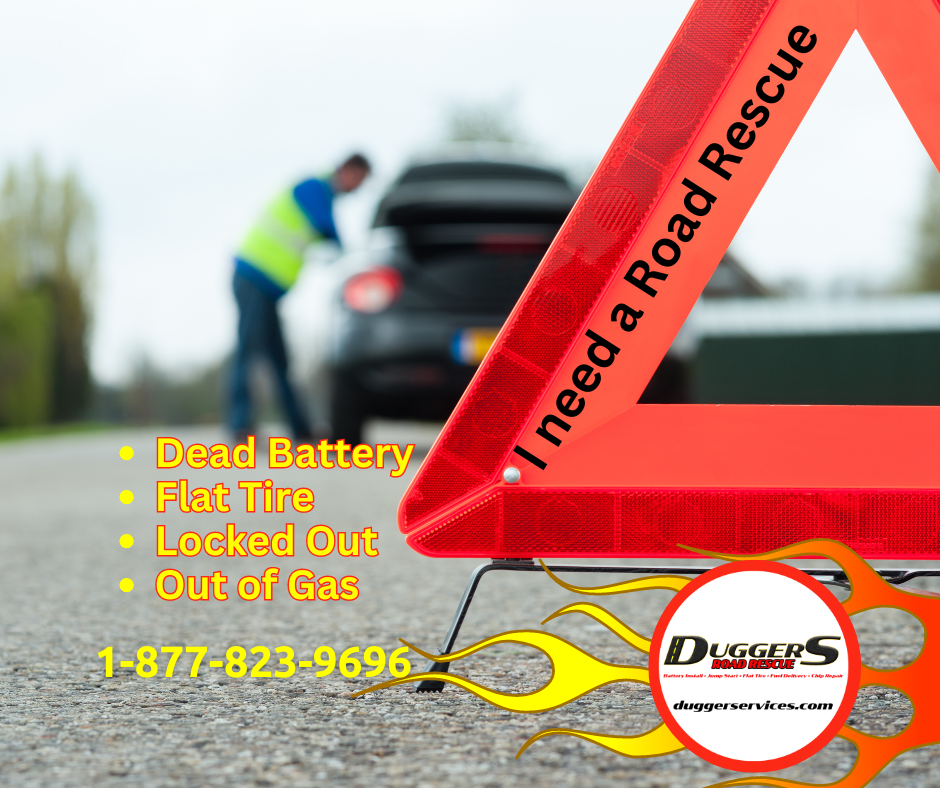
The most important thing in your emergency kit is a phone number. Save (877) 823-9696 in your contacts right now. Dugger’s Road Rescue provides 24/7 roadside assistance across the Phoenix metro, Tucson, and the greater Albuquerque area. Battery delivery, flat tire service, fuel delivery, lockout service, jump starts, and towing. Wherever you are, we come to you.
Get Ahead of Spring: Two Ways Dugger’s Can Help
For mobile battery testing, roadside assistance, and emergency service anywhere in Arizona or New Mexico, call Dugger’s Road Rescue at (877) 823-9696. We’re available 24 hours a day, 365 days a year, and we come to you.
For oil changes, brake inspections, AC service, and complete vehicle maintenance, visit Dugger’s Automotive Repair Facility on Camelback Road in Glendale. Call (505) 718-0412 or stop by. No appointment needed.
Winter is behind you. Take 30 minutes this week to check these seven items, and you’ll drive into spring with confidence.
Se Habla Español

