
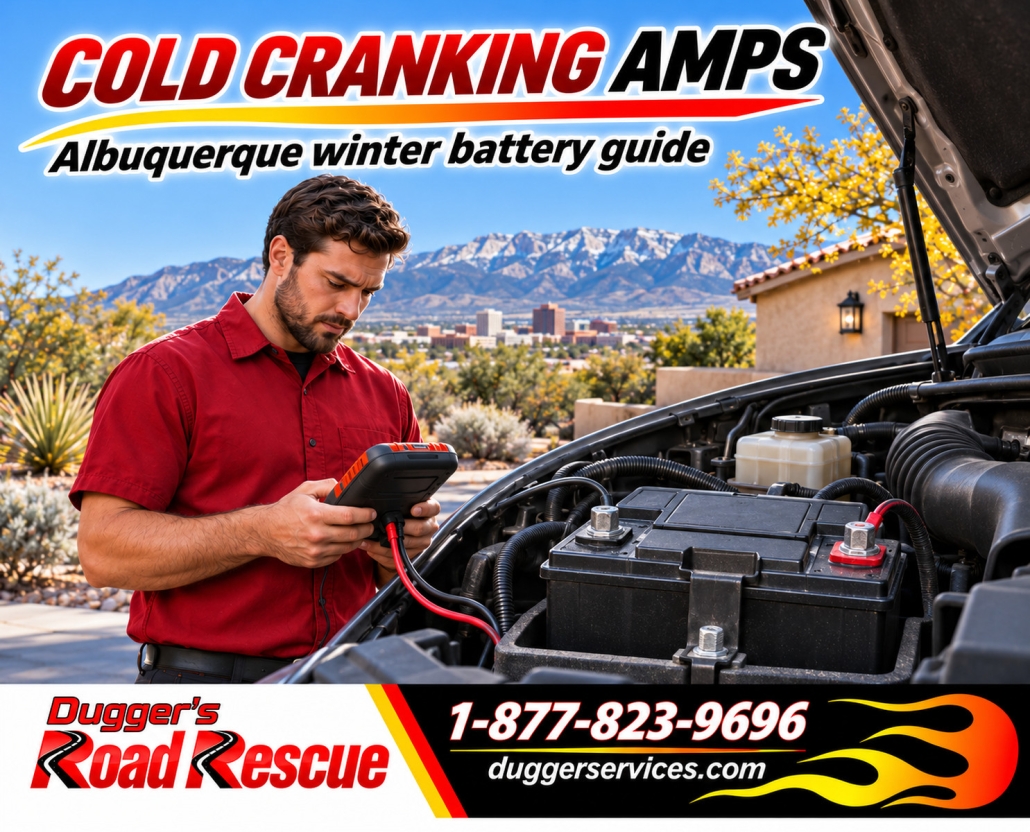
Cold Cranking Amps Explained: The Albuquerque Winter Battery Guide
Every car battery label has a number followed by three letters: CCA. Most drivers never look at it until the morning the car will not start. In Albuquerque in December, mornings often drop into the 20s, and that number matters. Here is what it means and how to choose the right battery.
- Cold cranking amps measure a battery’s starting power in the cold, the number that matters most on a December morning
- A battery that has been through a few summers delivers less than its label says
- The right battery fits your car, meets or beats its CCA requirement, and is the right type
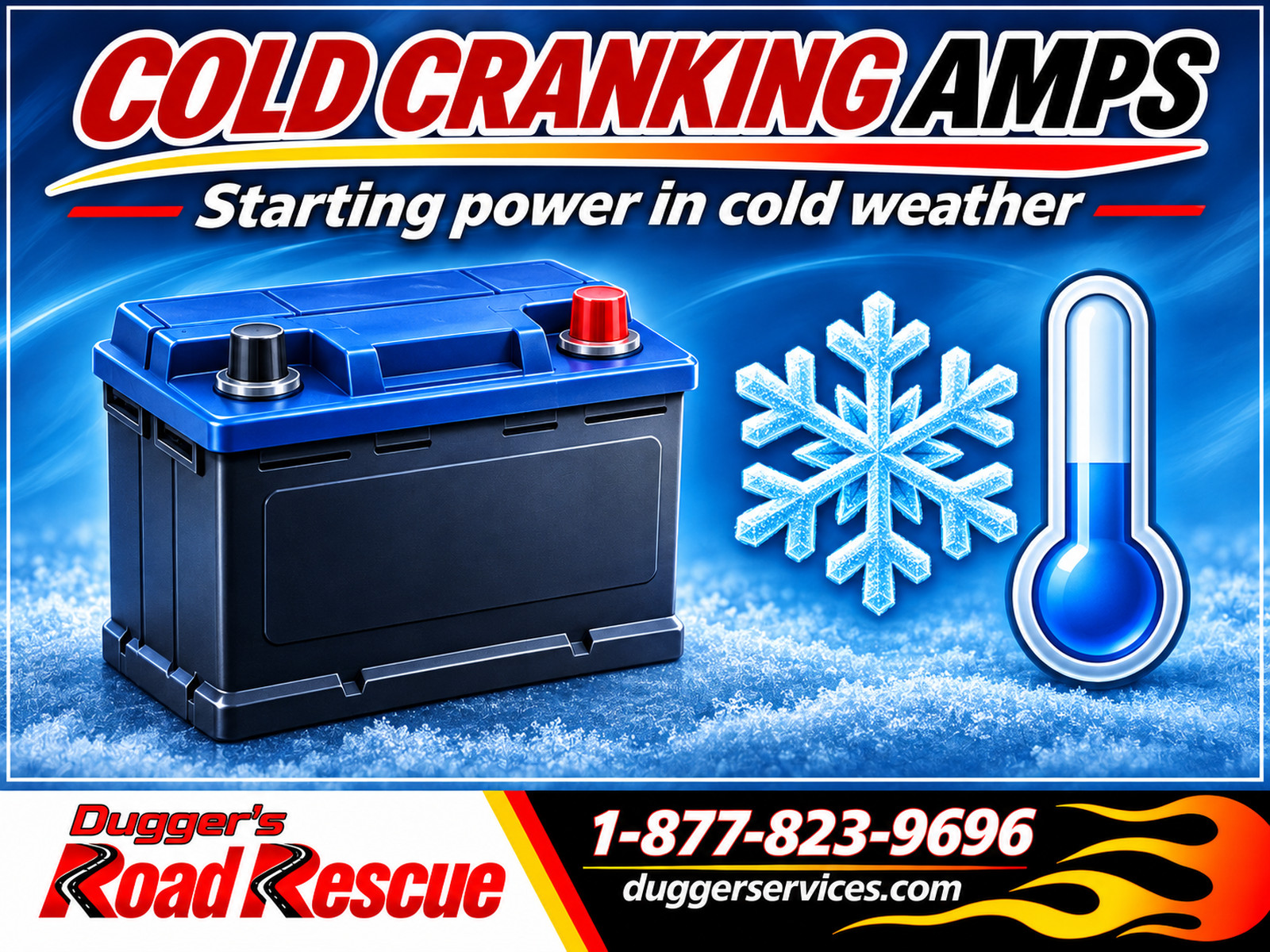
What Cold Cranking Amps Mean
Cold cranking amps, or CCA, is the amount of electric current a new, fully charged 12-volt battery can deliver for 30 seconds at 0 degrees Fahrenheit while staying at or above 7.2 volts. In plain words, CCA is how much starting power the battery has on a cold morning.
Cold makes starting harder in two ways. First, cold slows the chemical reaction inside the battery, so it can deliver less current. Second, cold makes the engine oil thicker, so the starter needs more current to turn the engine over. The CCA rating tells you how much extra power the battery has to handle both at once.
Why the Label Is Not the Whole Story
The CCA on the label describes the battery on the day it was made. After that, it starts to wear. Albuquerque summers bring afternoons in the 90s. Heat under the hood dries out the liquid inside the battery and wears away the metal plates that store its power. That damage is permanent. Each summer, it lowers the battery’s real starting power a little more.
That is why many Albuquerque batteries last about three to four years. A battery in its third or fourth winter may deliver well under the CCA printed on its label, and the label does not change to warn you. A battery test measures what the battery can really deliver and compares it to that rating.
Reserve Capacity in Plain Words
You may also see RC, for reserve capacity, on the label. It is the number of minutes a fully charged battery can supply a steady 25 amps before it runs too low to be useful. CCA is about starting the car. RC is about how long the battery can keep things running. It matters if the alternator (the part that makes electricity when the engine runs) stops working on the road.
The Daily Temperature Swing
Albuquerque winters are hard on batteries because of the big change between day and night. A sunny afternoon in the 50s can turn into a morning in the 20s. A car parked outside overnight is fully cold by morning, and so is its battery. Drivers who come into Albuquerque on I-40 from the mountains to the east often start the day in even colder air.
Short winter trips add to the problem. A quick drive with the heater on does not give the alternator time to put back the power the start used.
Matching CCA to Your Car
Your owner’s manual lists the battery group size (the battery’s physical size and terminal layout) and the lowest CCA your engine needs. Never install a battery below that CCA number, because it leaves no extra power for the coldest mornings.
Bigger is not always better. A battery with much more CCA than your car needs will not hurt it, but it will not make a healthy starter work any differently. It also has to fit the tray, hold-down bracket and cables. The goal is a battery in the correct group size that meets or slightly beats the CCA your car needs.
AGM or Flooded
A traditional flooded battery holds liquid inside. An AGM battery, short for absorbed glass mat, holds that liquid in fiberglass mats, and it handles being drained and recharged often better than a flooded battery. Many cars with start-stop systems (engines that shut off at red lights and restart when you let off the brake) need an AGM battery. If your car came with an AGM battery, replace it with another AGM. A flooded battery in a car built for AGM can wear out early and cause electrical problems. Many newer cars also need to be told that a new battery is in, a step called battery registration. We take care of it wherever it is needed.
What We Do on a Winter Call
Our mobile battery service comes to you anywhere in Albuquerque and Rio Rancho. We test the battery’s real output against its CCA rating and check the charging system. If the battery is worn out, we install one that meets your car’s needs on the spot and take the old one away. We also offer battery replacement in Rio Rancho at your home or work. Every battery we install comes with a 2-year warranty, and we dispatch 24 hours a day, 7 days a week, 365 days a year. If you only need power to get going, we also offer a jump start any hour. If you are ever stuck somewhere unsafe, call 911 first.
Frequently Asked Questions
What does CCA mean on a car battery?
CCA stands for cold cranking amps. It is the current a new, fully charged 12-volt battery can deliver for 30 seconds at 0 degrees Fahrenheit while staying at or above 7.2 volts. It is the best single measure of a battery’s starting power in cold weather.
Can I put a battery with higher CCA in my car?
Yes, as long as it is the correct group size and type and fits the tray, hold-down bracket and cables. Never go below the CCA your owner’s manual lists.
Does my car need an AGM battery?
If it came with one, yes. Many cars with start-stop systems need AGM, and replacing it with a flooded battery can shorten battery life and cause electrical problems.
Dugger’s Road Rescue
Albuquerque and Rio Rancho dispatch: (505) 823-9696.
Toll-free: 1-877-823-9696.
24/7/365. Se habla español.
