
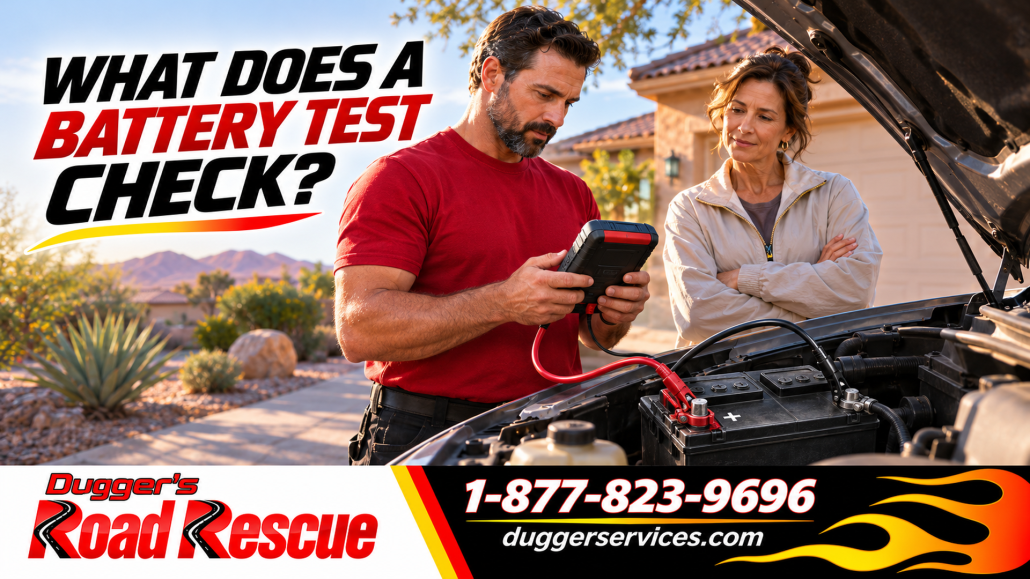
What Our Technician Actually Checks During a Battery Test
“Your battery is bad” is easy to say and hard to check. When a Dugger’s technician tests your battery, the goal is to give you a number you can see, not an opinion you have to trust. We test the battery and the charging system on every battery call, so you know whether a jump start will hold or a new battery is the better choice. A jump start will not help a battery that cannot hold a charge, and a new battery will not last on a car with a charging problem. Here is what the test covers, step by step, and what the results mean.
- A real battery test checks the battery, the starter’s draw and the charging system, not only the voltage
- A battery can read a healthy 12.6 volts at rest and still fail the moment it has to start the engine
- The result comes with a clear answer: good, good but needs a charge, replace, or a charging system problem
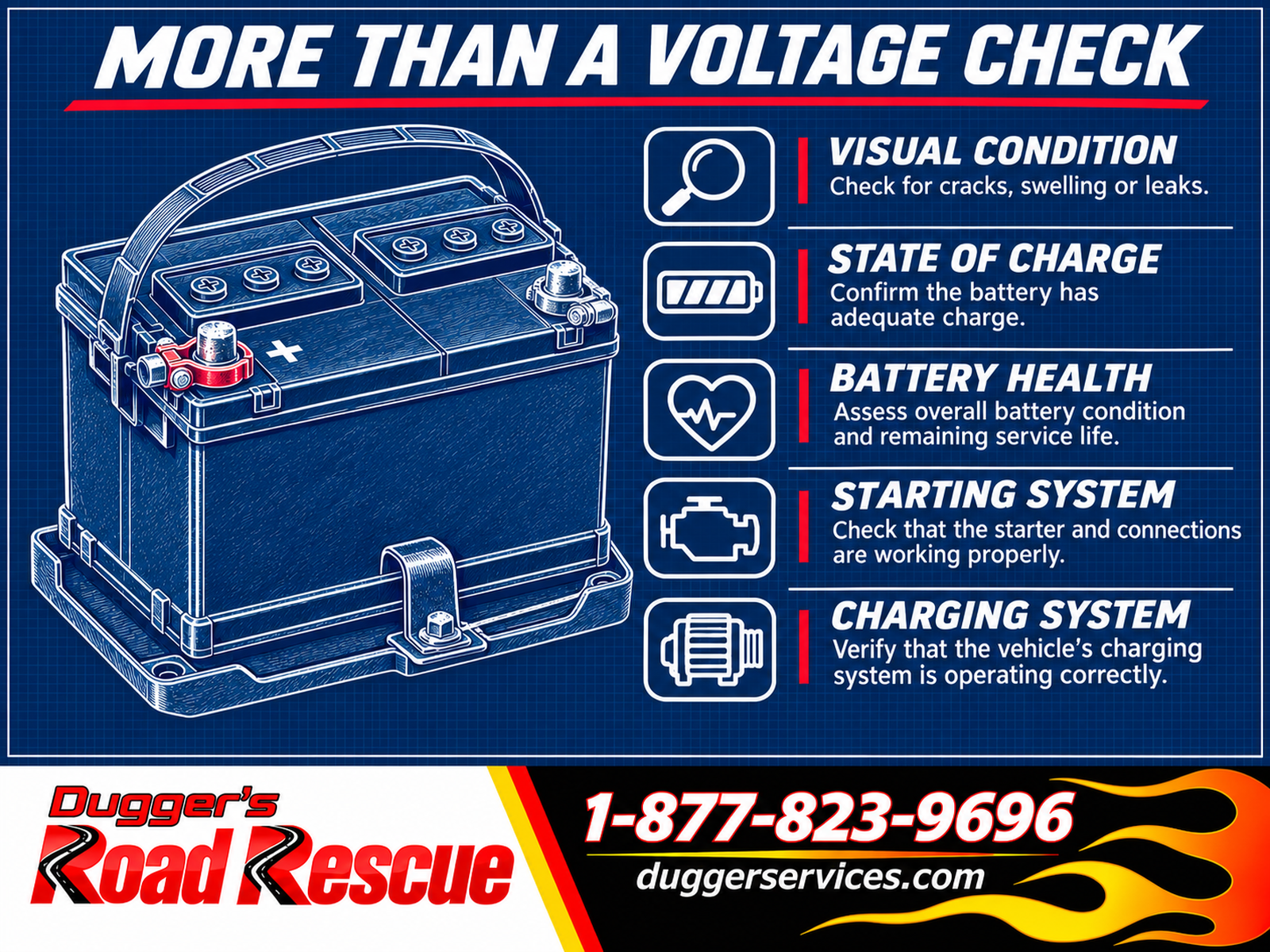
Step 1: A Close Look Before Any Tools
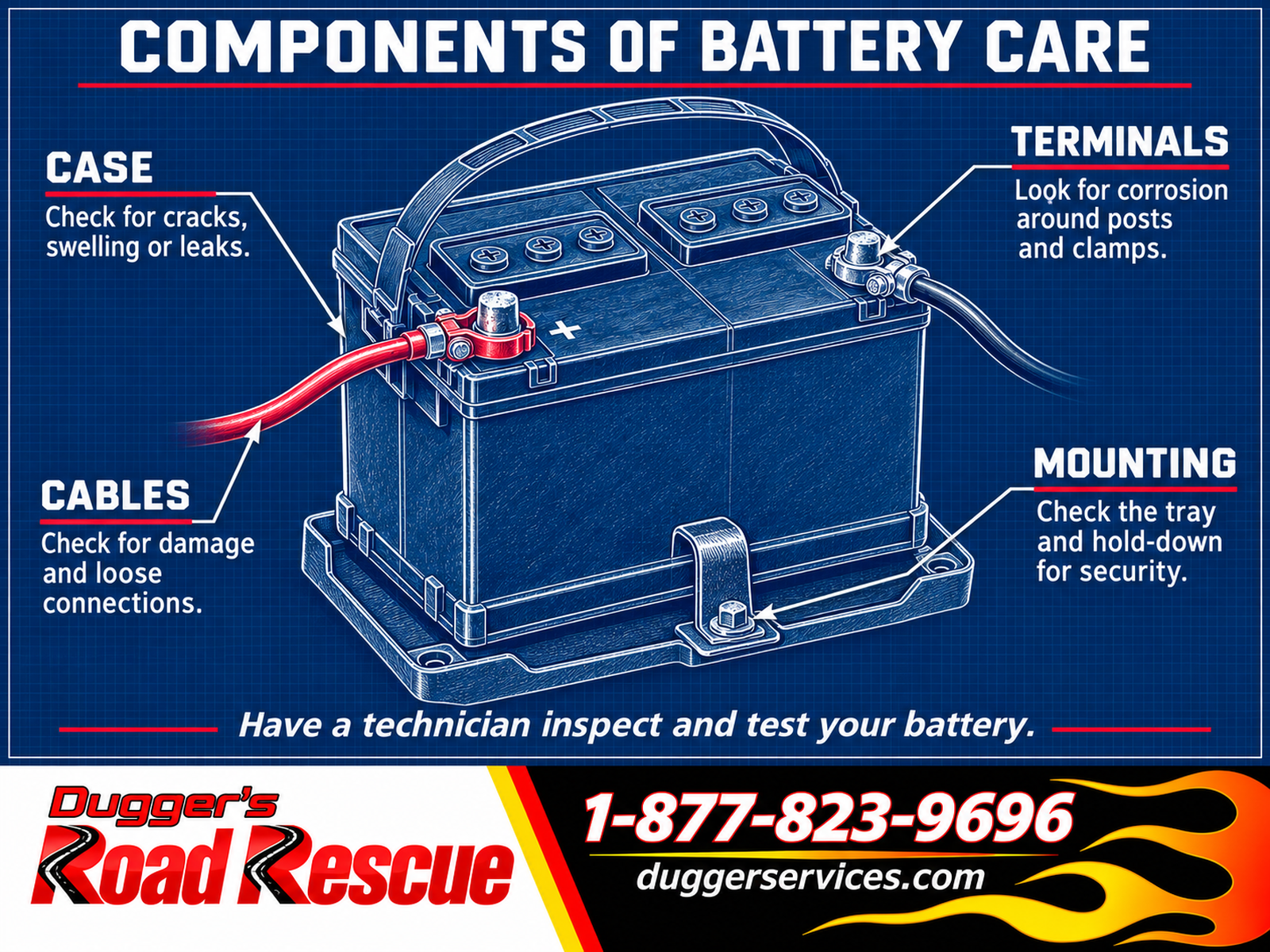
The test starts with the technician’s eyes. A cracked case, a leak, or sides that bulge outward mean the battery needs to be replaced no matter what a meter says. Next come the terminals, the metal posts where the cables connect. White, green or blue crust on the posts is corrosion. It makes it harder for power to flow, and a loose clamp can stop the car from starting all by itself. The technician also checks the hold-down, the bracket that keeps the battery in place. A loose battery gets shaken by every bump, and that shaking damages the plates inside.
Step 2: Resting Voltage
With the engine off, the technician reads the battery’s voltage. A fully charged 12-volt battery reads about 12.6 volts. Around 12.4 volts means it is roughly 75 percent charged. At 12.0 volts or below, the battery is nearly empty.
Resting voltage tells you how full the battery is, not how healthy it is. Starting an engine takes a large burst of power for a few seconds. A worn battery can show a full 12.6 volts while it sits, then drop sharply the moment the starter asks for power. That is why a voltage check alone misses many failing batteries.
Step 3: Testing Against the CCA Rating
Every battery label lists cold cranking amps, or CCA. CCA is the amount of current a battery can deliver for 30 seconds at 0 degrees Fahrenheit while still holding at least 7.2 volts. In plain words, it tells you how much starting power the battery has on a very cold morning. The technician enters that rating into the tester.
A conductance tester sends a small electrical signal through the battery and uses the result to estimate how much starting power it can deliver. A load tester puts a heavy draw on the battery, like a hard start, and watches how well the voltage holds. A battery that delivers well under its label is weak, even if it started the car this morning.
Step 4: Starter Draw
Next, the technician watches what happens while the engine cranks: how far the voltage drops. If a battery passes its test but the voltage still drops badly during the crank, the problem may be a starter that draws too much power, or a cable or connection that is losing power. If so, have a mechanic look at it.
Step 5: The Charging System
With the engine running, most cars’ charging systems put out roughly 13.5 to 14.7 volts. The technician checks that number to see whether the alternator keeps up. The alternator is the part that recharges the battery while the engine runs. If the reading is too low, the battery slowly runs down even while you drive. If it is too high, the battery is being overcharged, which damages it from the inside.
What the Results Mean
- Good: The battery passes.
- Good, needs a charge: The battery is healthy but low, often from short trips or sitting. A full charge brings it back.
- Replace: The battery fails under load. We can install a new one on the spot and take the old one away. Every battery we install comes with a 2-year warranty.
- Charging system problem: The battery may be fine. We tell you that plainly, instead of selling you a battery you do not need.
Many newer vehicles have a battery management system, or BMS. On many of these, the car has to be told when a new battery goes in, a step called battery registration or a BMS reset. We do it wherever the vehicle needs it.
Before Holiday Travel
Thanksgiving is about three weeks away. A long holiday drive, a cold early start or a week parked at the airport is a hard time to find out the battery is weak. Get it tested before you pack the car. We come to your home or workplace across the Phoenix metro, Tucson, Albuquerque and Rio Rancho, 24 hours a day, 7 days a week. If you are ever stuck somewhere unsafe, call 911 first.
Frequently Asked Questions
Can a car battery read 12.6 volts and still be bad?
Yes. Resting voltage shows how charged a battery is, not how much power it can deliver. A heat-worn battery can read 12.6 volts at rest and still fail when it has to start the engine.
Why does Dugger’s test the battery before a jump start or a new battery?
Testing first tells you which problem you actually have: a battery that cannot hold a charge, or a charging system that is not keeping the battery charged.
What should a charging system read with the engine running?
On most cars, roughly 13.5 to 14.7 volts. A reading well outside that range points to a charging system problem rather than the battery itself.
Dugger’s Road Rescue
Phoenix metro and Tucson: (602) 274-1506.
Albuquerque and Rio Rancho: (505) 823-9696.
Toll-free: 1-877-823-9696.
24/7/365. Se habla español.

